18 July 2018

Perth by-election: Jewish Community Issues

On behalf of the Jewish Community Council of Western Australia, I've written to the following candidates for the forthcoming by-election for the Federal Electorate of Perth as follows.

I'll shortly publish the responses we receive, so that you can see how your candidates stand on these issues.

Candidates for the Perth by-election
Ballot positionCandidate nameParty ballot name
1MATHESON, Julie
2ARIELLI, NicoleAnimal Justice Party
3GRAYDEN, JimIndependent
4DU PREEZ, WesleyLiberal Democrats
5SCOTT, ColinSustainable Australia
6MULLINGS, BenThe Australian Mental Health Party
7GORMAN, PatrickAustralian Labor Party
8HARFOUCHE, GabrielAustralian People's Party
9COLLINS, PaulIndependent
10PERKS, CarolineThe Greens (WA)
11HAMMOND, AScience Party
12JOUBERT, EllenAustralian Christians
13ROBINSON, TonyALA
14BRITZA, IanIndependent
15MASON, BarryCitizens Electoral Council

LETTER TO CANDIDATES:


Parliamentary Candidate for the Perth Electorate,

Dear (candidate)

Re: 2018 By-election Questionnaire

As the elected representative of the WA Jewish Community, through our 30+ constituent community organisations, we are pleased to provide the questionnaire appended below, addressing some of the issues that are important to us.

As a candidate for the Perth Electorate, which includes very many members of our community, we invite you to respond with your replies or your comments, which we will disseminate to the community for you. We are most interested in your personal views, as an indicator of your prospective stance within your Party, should the Party policies on these issues be subject to debate within the Party.

We also invite you to discuss any of these issues, by phoning me at your convenience. If you prefer, we’ll be pleased to meet with you.

Your faithfully,
Steve Lieblich

Director of Public Affairs, Jewish Community Council of WA


1.  Safety and Security

The Jewish Community is increasingly concerned about the safety and security of community members and assets. (Refer to Appendix 1 – Jewish Community Security.)

Do you envisage any changes to government support and funding of Jewish-community security? If so, what changes?

2.  Private Schools

Do you envisage making changes to government funding of our Private Schools? If so, what changes?


3.  Religious Freedom

Observance of the Jewish religion and customs include the ritual circumcision (“brit milah”) of male children at the age of 8 days and observing Jewish dietary laws (eating food that is rabbinically-certified as kosher). Do you envisage making changes to any of the following? If so, what changes?
·         regulation of brit milah
·         regulation of kosher slaughter (“shechita”)
·         regulation of kosher certification


4.  Israel

Our community overwhelmingly supports Zionism as the modern political movement for the self-determination of the Jewish people; and Israel as the homeland of the Jewish people.

Do you support those notions?
Do you support the strengthening and enhancement of government-to-government and people-to-people ties between Australians and Israelis at all levels, including trade/economic, academic and cultural ties?

Do you consider Australian-media reporting on Israel to be fair and unbiased? If not, would you take any specific action or make any statements to promote fair, unbiased reporting?

Arab leaders have created a culture and a system of payments that incites hatred and motivates terrorism. (Refer to Appendix 2 – Incitement to Terror.) About a third of the Palestinian Authority’s budget is financed by foreign aid. Do you support Australia making its aid to the PA contingent on cessation of such support for terrorism?

There have been calls for unilateral recognition of a “Palestinian” State that does not yet exist. Such moves will prolong the conflict and would be contrary to the interests of all people in the region, above all the Arabs (Refer to Appendix 3 – Unilateral Recognition of a “Palestinian State”.) Will you take any action to oppose Australian recognition of such a unilateral declaration?

5.  Global Antisemitism

There is a global campaign to delegitimize Israel’s right to exist, including a “Boycott, Divestment & Sanctions (BDS) campaign, which is aimed at destroying Israel, in the guise of promoting peace between Israel and its neighbours. (Refer to Appendix 4 – The BDS Campaign.)

Will you take any action or make any statements to stop this hateful campaign in Australia and globally?

6.  Antisemitism in Australia

Our community has a high degree of concern about the influence, in Australia, of anti-Israel and anti-Zionist movements such as the Boycott Divestment and Sanctions (BDS) campaign and other forms of de-legitimisation of Israel and the cover they provide for anti-Semites to express their hatred.

Do you envisage taking any action in relation to any of the following? If so, what action?
·         Legal protections against promotion of racial hatred and of racially-motivated violence.  
·         The activities of radical preachers in schools and religious institutions.
·         Public and school education campaigns against violent and/or extremist ideologies.


7.  Relations with Iran

Iran continues to contravene its international obligations; extend its threatening military posture in Yemen, Iraq, Syria, Lebanon and elsewhere; and remains the greatest state sponsor of global terrorism. The USA has withdrawn from the JCPOA and is apparently moving to declaring a list of verifiable demands for Iran to demonstrate its good faith in the community of nations. (Refer to Appendix 5 – Iran: a Rogue State.)

Will you support a USA-led diplomatic effort to prevent Iran from ever gaining access to nuclear weapons, to desist from terrorism and cease support for foreign terrorists and militias? 


Appendix 1 – Jewish Community Security

Security costs include one-off capital costs to harden buildings against potential attacks as well as the recurring operations costs of monitoring systems and guards. The latter are a growing concern and drain on our communal resources.
Our communal dollars are needed for a myriad of worthy causes, such as youth programs, education, aged care and welfare, but we are finding it increasingly difficult to give physical security the priority it requires. We currently receive government funding assistance towards the security costs of Jewish day schools.

Appendix 2 – Incitement to Terror

Arab terror attacks in Israel result from explicit calls by the Arab leaders to “spill blood.” Arab children have been taught to idolize the murder of Jews as a sacred value and to regard their own death in this “jihad” as the pinnacle of their aspirations.
The PA incites antisemitism, glorifies martyrdom and encourages terrorism, by awarding generous lifetime pensions to terrorists and their families, on a sliding scale – the more Jews they kill, the higher the pension.
An apprehended terrorist told interrogators in Israel last year: "I've accumulated large debts... I decided to do something serious, such as committing murder... and then my family will get money (i.e., from the PA) and will live comfortably... "
In June 2017, PA District Governor, Laila Ghannam, praised the "Martyrdom " of a 17-year-old terrorist who was shot and killed while throwing Molotov cocktails at Jewish civilians, praising the fact that rather than obtaining matriculation this summer, the terrorist "achieved the highest Martyrdom".
The PA’s incessant incitement perpetuates the conflict and grooms the next generation of terrorists by naming streets, public squares and even children's soccer tournaments after terrorists. In May 2017, the PA inaugurated the Martyr Dalal Mughrabi Center, named after a terrorist leader in the murder of 37 civilians including 12 children, in the Nablus district. In April 2017, Safa, the daughter of Abdallah Barghouti, a terrorist who prepared explosives for attacks in which 67 were murdered, read a letter to her father at her school assembly saying: "Father, I am very proud of you".
The apathy shown by the international community to this death-culture, and the unbalanced manner in which subsequent violence is often treated by the international media is doing long-term, and possibly irrevocable, harm to the Arabs themselves, more than to anyone. Yet there is little international opposition to the exploitation of Arab children.


Appendix 3 – Unilateral Recognition of a “Palestinian State”

Proposals to unilaterally recognise a “Palestinian state” will encourage further Arab terrorism, prolong the conflict, and would be contrary to the interests of all people in the region, above all the Arabs.
Another Arab state formed outside the framework of a peace treaty with Israel will almost certainly be in a de facto state of war with Israel, and a platform for intensified attacks on Israel. Indeed, its legitimacy with the Arabs of the region will be defined by its commitment to the eventual destruction of the Jewish state.
Israel’s Arab neighbours, since the late 1800s, have rejected peaceful coexistence with Jewish immigrants to the region seeking self-determination in the ancient Jewish homeland. The first proposal for a “two-state solution” was the 1935 British Peel Commission Report, in response to Arab pogroms and riots in the 1920s and 1930s. The Arabs refused that proposal to share the land then, and have continually refused to do so since then, through to the most recent generous offers of statehood in 2000, 2001 and 2008.
This century of Arab intransigence is apparently motivated by a persistent rejection of Israel's right to exist, and an incalcitrant attempt to destroy the re-established Jewish state by insisting on a "right of return" to Israel, for the uniquely-defined “Palestinian refugees”, which includes not only those who lost their homes in war, but also their millions of descendants, even though they may have never set foot in Israel and are settled elsewhere. 
The Arabs of the region don’t have the fundamental elements of statehood. Its borders are not defined, and it doesn’t have a central government with a monopoly on military force. The government is split between Hamas and the PA.
In Gaza, Hamas brutally seized power in 2005, and holds it by violent intimidation. It is globally recognized as a terrorist entity with an open objective of genocide. Mahmoud Abbas, the purported President of the proposed “Palestinian State” dare not visit Gaza for fear of his life.
In Judea and Samaria, Abbas who rules the Palestinian Authority, is in the 14th year of his 4-year term. While he feigns statesmanship globally, he leads a regime with the same genocidal objectives as that of Hamas.
Rather than negotiating a peaceful resolution to the conflict with Israel, the PA has focused on promoting recognition of their non-existent “state” from as many governments and international organisations as possible. This avoids having to reconcile themselves to living peacefully with a neighbouring Jewish state and making the compromises necessary for genuine peace. Regretfully, some commentators in Australia have fallen for this ploy.
Supporting unilateral recognition of a Palestinian state rewards and encourages the most destructive Arab tactics, to the detriment of the future of all people in the region. People of good will should be urging the Arabs to negotiate in good faith with Israel, and to genuinely accept Israel's right to exist, which is the only way to achieve peace. Rewarding them for inciting hatred and violence, and for refusing to negotiate, only makes peace more distant.

Appendix 4 – The BDS Campaign

The Boycott, Divestment and Sanctions (BDS) campaign is a product of the NGO Forum held in parallel to the 2001 UN World Conference against Racism in Durban, South Africa, which was marked by repeated expressions of naked anti-Semitism and condemned as such. The declaration established the “Durban Strategy”, promoting “a policy of complete and total isolation of Israel, the imposition of comprehensive sanctions and embargoes, [and] the cessation of all links (diplomatic, economic, social, aid, military cooperation and training) between all states and Israel”.
In deliberately drawing a false parallel to South African apartheid and promoting a campaign like that, which eventually led to the downfall of that despicable system, the “Durban Strategy” declared that “Israel should be subject to the same kind of attack, leading to the same kind of result.”

Appendix 5 – Iran: a Rogue State

Civil wars in Iraq and Syria have fundamentally changed the Islamic Republic of Iran. They have become arenas for a new militant Shi’ite solidarity that has crossed the Arab-Persian divide: Iranian-led, non-Iranian militias, thousands strong, now fight in foreign lands from Yemen to Lebanon. The Islamic Republic now resembles the Soviet Union of 1979: a police state, incapable of reforming itself while drowning in corruption, expanding abroad to protect the pseudo-theocratic, tyrannical regime.
A major point of contention between the U.S. which has now withdrawn from the JCPOA, and Europe (and to a lesser extent Australia), is how to remediate the sunset clauses of the JCPOA, by which critical restrictions on the Iranian nuclear program on expire on a preset schedule.
Recent intelligence gained from a secret Iranian warehouse shows that the scope of Iran’s weaponization program was likely far greater than suspected. It indicates that Iran sought to preserve its ability to weaponize for the indefinite future. This has shattered a core assumption that Tehran would have neither the intention nor the capability to build a nuclear explosive device or affix a nuclear warhead to a delivery vehicle.  Given that the JCPOA sunset clauses would allow Iran to build an industrial-size enrichment program and shrink its breakout time from one year to less than a few weeks, it’s now imperative that the JCPOA is replaced.

06 July 2018

Time for Australia to support US pressure on the Iranian Mullahs

From The Australian, July 6, 2018, by COLIN RUBENSTEIN*:

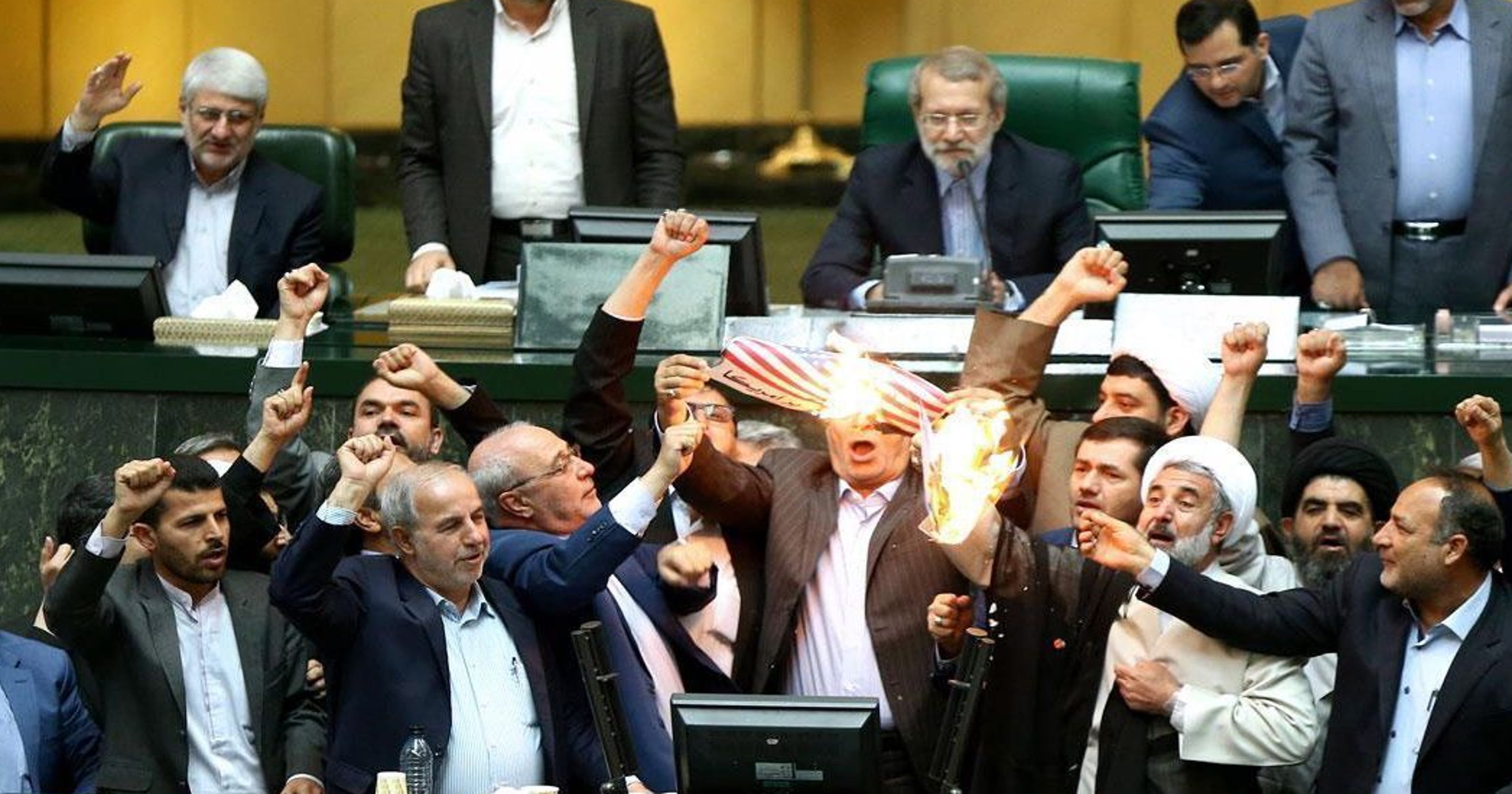
Image result for iran death to america 2018

With widespread, daily protests in the streets, and shouts of “death to the dictator” heard in Tehran, the Iranian regime is under pressure like seldom before.

These protests are primarily driven by economic issues — but Iran’s economic woes are likely to worsen as, in anticipation of renewed US sanctions, leading international companies are pulling out of dozens of signed agreements with Iran worth billions of dollars.

These developments significantly strengthen the case for the Trump administration’s new Iran strategy. After President Donald Trump’s May 8 announcement that he was withdrawing the US from the flawed Iran nuclear deal known as the Joint Comprehensive Plan of Action, on May 21 US Secretary of State Mike Pompeo outlined a comprehensive strategy to put pressure on Iran over its rogue behaviour across 12 issue areas, including missiles, cyber terror, support for destabilising activities in Iraq and Yemen and the Taliban in Afghanistan, funding of terror groups such as Hamas and Hezbollah, as well as ending ongoing uranium enrichment and other efforts to build nuclear weapons.

Pompeo specifically mentioned Australia as one of four countries he hoped would help support the new strategy. Recent events in Iran have only strengthened the case for Canberra to consider doing so in Australia’s national interest.

Renewed US sanctions haven’t even begun, yet their mere anticipation is having a domino effect across the Iranian economy.

Boeing backed away from the deal to supply more than 100 planes to Iran’s ageing air fleet, while Europe’s Airbus is expected to cancel its similar sale.
Car manufacturers Peugeot and Citroen’s joint ventures with Iran have been shut down. General Electric and Honeywell have decided not to ship desperately needed equipment and services to Iran’s vital energy sector. French oil majors Total and Engie, as well as BP, also have announced they are backing away from agreements with Iran.

The list goes on and on, lengthening daily. Things are only going to worsen for Iran. Next month, limitations on Iran’s access to the SWIFT international banking system will effectively isolate the Iranian economy from most global trade.

In November, more limitations will be imposed on Iran’s oil and energy exports, shipping and ports, and international financial transactions.

The anticipated effects of these measures have seen the value of the Iranian rial plummeting against all international currencies, despite the regime’s desperate efforts to try to contain the never-ending devaluation. In three months, the rial price of gold has tripled.

Meanwhile, the regime must be close to panic as the mullahs witness the intensifying wave of protest and unrest in recent weeks. Despite notoriously vicious and repressive police, there have been protests in hundreds of cities — including in the regime’s conservative heartland — which have led to dozens of deaths and the detention of thousands.

Furthermore, in a recent development, the merchants of the famous Tehran Bazaar joined the calls for freedom and went on a general strike. “Bazaaris” from other cities have joined in.

This is a significant event because during the 1979 Islamic revolution against the shah, it was the shift of the normally conservative merchants that signalled his rule was doomed.

The message of the protesters was clear, as they chanted “Palestine and Syria are reasons for our misery”, and “not Gaza, not Lebanon, my life only for Iran”. The Iranian people are angry at their corrupt and oppressive government, which stifles their freedom and fails in managing the crippled economy while spending at least an estimated $US16 billion ($21.6bn) annually on exporting terrorism and its war efforts in Syria.

Critics of the new US-Iran strategy have argued that it was hopelessly unrealistic. They argued that without consensus support of the international community and UN Security Council sanctions, the US alone would never be able to generate sufficient pressure to force the Iranian regime to make compromises it previously rejected.

The events of recent weeks strongly suggest otherwise. The Iranian regime is clearly under pressure as never before — including before the 2015 JCPOA deal.

Given this, countries, including Australia, that have continued to support the joint plan or are sceptical of reinstating sanctions, need to reconsider.

Is Australia’s national interest best served by clinging to the flawed JCPOA? Doing so would not only alienate and anger the US, our most important ally, but also almost all the Sunni Arab states, which see Iran and its allies as an existential threat and are fully on board with the new US approach.

Moreover, the plan has not been working.

It is not just that the agreement effectively permits Iran to break out to develop a nuclear bomb in 10 to 15 years, while also allowing it to continue to work on missiles to deliver those bombs in the meantime. It also provided the money to expand the destabilising efforts of the Islamic Revolutionary Guard Corps, responsible for spreading the revolution regionally through extensive, far-flung interventions in Syria, Yemen, Iraq, Afghanistan and Lebanon, and directly funding, training and arming banned terror groups such as Hezbollah and Hamas.

Astute policymakers will recognise the present unique opportunity to leverage the intense and growing economic pressure on Iranian regime decision-makers. Tehran’s mullahs clearly have overreached and left themselves vulnerable; now is the time to force them to pull back from their highly dangerous behaviour abroad or risk the continued viabil¬ity of their revolutionary Islam¬ic regime at home.

It is in Australia’s interest to seize this new opportunity to join international efforts to achieve a better outcome for the region, and indeed Iran’s people, by challenging and reversing Iran’s highly destabilising rogue behaviour and threatening regional hegemony aspirations.

*Colin Rubenstein is executive director of the Australia/Israel & Jewish Affairs Council.

03 July 2018

Australia should not fund Palestinian “pay to slay”

From AIJAC, April 3, 2018, by Sharyn Mittelman*:
An edited version of this article appeared in the Daily Telegraph – 2 April 2018

A key obstacle to peace between Israelis and Palestinians is the institutionalised incitement to anti-Israel violence by the Palestinian Authority (PA). Such incitement includes the naming of public streets and buildings after terrorists and encouraging “martyrdom” throughout the media, even in children’s television programs.


Perhaps the worst aspect of this incitement, however, is the PA’s “martyr” compensation scheme, which incentivises terrorism by providing lifetime monthly stipends to convicted terrorists relative to their sentences and to the families of slain terrorists. The worse the crime you commit, the more money you receive. The PA recently announced that its budget for 2018 will include US$403 million for such payments.

The United States Congress has now decided to act against this nefarious scheme. The Taylor Force Act, officially passed on March 23, requires that the US halt its funding to the PA if the latter refuses to end its “martyr” compensation program.

The legislation is named after an American citizen and US army veteran Taylor Force who was killed in a stabbing attack by a Palestinian terrorist in Jaffa, Israel in 2016 which also injured eleven people. Given that the terrorist who killed Force died while committing an act of terror, his relatives are paid a monthly stipend by the PA’s Martyr’s Fund.

The White House said in a statement that it “commends the Congress for including the Taylor Force Act, which prohibits most US foreign assistance that directly benefits the Palestinian Authority (PA) until the PA ends the abhorrent practice of providing payments to terrorists and their families in reward for acts of violence.”

The legislation has achieved bipartisan support. Democratic New York Senator Chuck Schumer, the Senate minority leader, said that the “passage of the Taylor Force Act will serve as a shot across the bow to President Abbas, as he must be held accountable for the Palestinian Authority’s record of incitement and subsidizing of terror. It is my hope that by enacting this bill we can put an end to the Palestinian Authority’s disturbing practice, all while honoring the memory and sacrifice of Taylor Force.”

The legislation includes exemptions for PA projects that will continue to receive US funding including hospitals in east Jerusalem, wastewater programs and child vaccination initiatives. Moreover, the US will continue to provide funding for the PA’s security and intelligence forces, which have cooperated with Israel in thwarting terror attacks.

PA President Mahmoud Abbas disappointingly condemned the Bill and vowed to continue to pay the families of “martyrs and prisoners.”

The Palestinian Liberation Organisation (PLO) envoy to Washington, Husam Zomlot, also criticised the legislation as politically motivated, and ironically said that the Bill “punishes” the PA, “which is the only agency committed to peace and nonviolence, and undermines the American-Palestinian bilateral relationship and decades of US investments in the two-state solution.”

Zomlot’s statement demonstrates the hypocrisy and double-dealing of the PA. It cannot claim that it is committed to “non-violence” while it is encouraging its people to become terrorists by providing financial incentives. If it truly wants to be considered as committed to non-violence, then it should eliminate its institutionalised incitement.

The Australian government should now consider the relevance of the Taylor Force Act to Australian funding to the PA. In January last year, Tony Abbott called for Australia to cut our $40 million annual aid budget to the PA while it “keeps paying pensions to terrorists and their families”.

In response, Foreign Minister Julie Bishop said Australia’s aid to the Palestinians has “robust risk management and due diligence assessment processes” that also apply to partner agencies and governments. In addition, Bishop said the government had a “zero tolerance policy” for fraud and corruption, referring to the suspension and review of funding following 2016 allegations that a World Vision employee was redirecting funds to Hamas.

Moreover, according to the Department of Foreign Affairs website, the Australian government does have a plan to “reduce the proportion of program resources that flow to the PA and increase the proportion that goes directly to promote economic growth in the agriculture sector.”

It is true that we can follow the money we provide the PA to ensure it doesn’t go directly to funding terrorism, but our funds still free up other money the PA can then use for its terror incentive scheme.
However, the passage of the Taylor Force Act sends a strong message to the PA that it can no longer have it both ways – it cannot pretend to be a partner for peace in English, and call for martyrs in Arabic, and then pay terrorists and their families. This message to the PA will be even stronger if it is supported by other principled actors in the international community, such as Australia.

*Sharyn Mittelman is a Senior Policy Analyst at the Australia/Israel & Jewish Affairs Council.

28 June 2018

Australian Unions channelled millions of dollars to an organisation that employed a terrorist leader

From the Daily Telegraph, June 27, 2018, by Sharri Markson:

AUSTRALIAN taxpayer funds are being funnelled to a Palestinian aid organisation that has employed and supported a leader of a terrorist group in Gaza.

The Daily Telegraph can reveal the Department of Foreign Affairs and Trade (DFAT) has given at least $21 million in the past decade to a Sydney-based charity set up by the unions, Union Aid Abroad (APHEDA).

This charity then channelled millions of dollars to the MA’AN Development Centre — a Palestinian organisation that employed a leader of the Popular Front for the Liberation of Palestine (PFLP).

The revelations have prompted Foreign Minister Julie Bishop to announce an audit of the union funding, understood to have been decided by her department.

PFLP has been on the official terror lists of the United States, European Union and Canada as a result of its hijacking of planes, assassinations and suicide bombings, while Australia has the group on its “Consolidated” list of organisations subject to financial sanctions as a result of security threats.

One of the MA’AN Development Centre’s 36 staff working in Gaza was Ahmed Abdullah Al Adine, 30, who held the job of Project Co-ordinator and Field Monitor since 2012.

Al Adine was also a leader of the PFLP in Gaza until he was killed in border protests last month. The terror group now hails him as a “martyr” and gave him a grand funeral last month, attended by at least a dozen PFLP terrorists.

Image result for Ahmed Abdullah Al Adine funeral
Funeral of terrorist Ahmed Abdullah Al Adine 

Union Aid Abroad — APHEDA, which describes itself as a “justice organisation of the Australian union movement” and provides funding to human rights causes around the world, issued a media release about the death of Al Adine.
“Union Aid Abroad — APHEDA is particularly sad to report that a colleague working with the MA’AN Development Centre, our partner organisation in Gaza, was killed during the protests,” APHEDA’s May 15, 2018 media release states.
The Popular Front for the Liberation of Palestine’s website states that their “ martyred comrade” Al Adine was a member of their leadership team in Gaza.
“With deep pride, the Popular Front for the Liberation of Palestine salutes its esteemed martyr, Ahmad Abdullah al-Adaini (sic), who was martyred as he participated in the uprising of return near al-Bureij,” a May 16 statement on his death reads.
“The martyred comrade was born in the Gaza Strip in 1981 to a family from Tarabin in Bir Saba. He was a member of the leadership of the PFLP in Deir al-Balah and its secretary and a member of the Palestinian Progressive Youth Union.
 “His vast capabilities made him an esteemed contributor to the struggle; he never left the field and especially the march for return, carrying high the banner of its goals and advancing with his comrades until his death.”
On Al Adine’s personal Facebook page, he states his occupation is a “project co-ordinator” for MA’AN Development Centre. On May 9 and May 7 he posted photographs featuring PFLP flags and PFLP propaganda.

He also posted PFLP press statements and frequently wrote incendiary comments about the death of Israel, while celebrating martyrdom.

His funeral was guarded by more than a dozen armed men wearing balaclavas with the PFLP logo on bandannas, and his funeral image also had the PFLP logo on it.

The group has been responsible for a spate of terror attacks dating back to 1968 when it hijacked a commercial El Al Flight and held hostages captive for 40 days. The incident has been described as laying the foundation for al-Qaeda’s September 11 attacks.

More recent incidents include 

  • a 2015 attack on Israelis driving in a car, 
  • an assassination plot against ¬Israeli Prime Minister Benjamin Netanyahu, 
  • a 2014 massacre in a Jerusalem synagogue where four Jewish worshippers and a policeman were killed and a further seven were injured, 
  • a 2012 attack involving firing an antitank missile explosive device and, 
  • a month earlier, detonating a roadside bomb targeting an Israeli Defence Force patrol in southern Israel, 
  • among others.

PFLP also claimed responsibility for a spate of suicide bombings in 2002 to 2004 which killed Israeli civilians, and assassinated Israeli Minister for Tourism Rahevam Zeevi and Israeli head of security Meir Lixenberg in 2001.

APHEDA received $8.6 million in government funds from 2011 to 2015 and is budgeted to get another $5.1 million from 2016 until 2019.

Its annual report for 2017-18 states 40 per cent of its income is from government funds. Its total funding encompasses donations from many Australian unions including 

  • Australian Workers' Union, 
  • Finance Sector Union, 
  • Health Services Union of Australia, 
  • MEAA, 
  • NSW Police Association, 
  • Rail, Tram and Bus Union, and 
  • Communications Electrical and Plumbing Union, among others. 
There is no public information for how much funding APHEDA currently gives to the MA’AN Development Centre. It referred questions to DFAT.

In 2011 AusAID revealed MA’AN had received $1.2 million from Union Aid Abroad — APHEDA in the 12 months to April 30, 2010.

...Ms Bishop said Union Aid Abroad was a longstanding Australian aid partner...

27 June 2018

Israel boycotter to address NSW Labor Conference

From The Australian, 28 June 2018, by Andrew Clennel:

Peter Manning will host an event for Labor Friends of Palestine on Saturday. Picture: AAP
Peter Manning will host an event for Labor Friends of Palestine on Saturday. 
Picture: AAP

A former senior ABC journalist who has advocated for boycotts of Israeli products is a speaker at a Fringe event at this weekend’s NSW Labor conference...

Peter Manning, who in 2009 signed off on a letter with fellow academics urging the boycott of Israeli institutions and who chaired forums in Marrickville for the “Boycott Divestment and Sanctions” group, is headlining an event for the “Labor Friends of Palestine”.

The web page for the conference says of Dr Manning’s involvement:
“In this event, we will discuss the evolution of Labor’s Foreign Policy and examine how we can navigate and profit from the challenges we face in a rapidly evolving and changing region.
“The event will be presented by Dr Peter Manning, the known Australian journalist, author, broadcaster, commentator and academic, followed by a Q&A session.”
NSW Jewish Board of Deputies chief executive Vic Alhadeff said yesterday it was 
“appalling that an active proponent of boycotting Israel who accuses Israel of apartheid, colonialism and ethnic cleansing is accorded a platform at the State Labor conference... It’s an unequivocal repudiation of the sensible voices within Labor ...”.
...Dr Manning has previously chaired forums for the Marrickville BDS Group — the primary group that pushed BDS through Marrickville Council in 2011.

In 2009 he signed a letter that called for universities to 
“refrain from participation in any form of academic and cultural co-operation, collaboration or joint projects with Israeli institutions”...

Editor's note:

The BDS campaign is aimed at destroying Israel, not promoting peace between Israel and its neighbours. 

It is a product of the NGO Forum held in parallel to the 2001 UN World Conference against Racism in Durban, South Africa , which was marked by repeated expressions of naked anti-Semitism and condemned as such by the United States government and  the United Nations High Commissioner for Human Rights Mary Robinson.

The Forum’s final declaration described Israel as a state that was guilty of “racist crimes including war crimes, acts of genocide and ethnic cleansing.” The declaration established an action plan—the “Durban Strategy”—promoting “a policy of complete and total isolation of Israel . . . the imposition of mandatory and comprehensive sanctions and embargoes, the full cessation of all links (diplomatic, economic, social, aid, military cooperation and training) between all states and Israel” 

The BDS movement deliberately draws a false parallel to South African apartheid . According to BDS proponents, if South Africa was worthy of a boycott and sanctions campaigns that eventually led to the downfall of that despicable system, “Israel should be subject to the same kind of attack, leading to the same kind of result.”

13 June 2018

"Racism dressed up as scholarship..."

From The Australian, 13 June 2018, by Paige Taylor:


Sandra Nasr: “crude prejudice and lack of scholarly rigour ..."

A Perth academic who criticised Israeli policies in a PhD eight years ago says she is the subject of sustained attempts to silence her on the topic of Palestinian human rights.

Sandra Nasr’s 2010 thesis is the subject of a complaint to the Tertiary Education Quality and Standards Agency by the president of the Jewish Community Council of Western Australia, Joan Hillman, who alleges it contains “improprieties”, citing “crude prejudice and lack of scholarly rigour of the thesis (as now attested to by three independent academic scholars); apparent conflicts of interest by the two examiners; and the university’s … placing the thesis under permanent embargo in 2010”.

Dr Nasr, a lecturer in politics and history at Notre Dame in Western Australia, said her thesis was passed in line with Curtin University’s PhD candidate admission and supervisor and examiner review processes. In it, she “critiqued Israeli policies and practices of occupation within the framework of critical state terrorism … These attacks on academic freedom are part of a sustained attempt to redefine criticism of Israel or Zionist ideology as anti-Semitism in order to silence those who would express concern regarding Palestinian human rights under Israeli occupation.”

The complaint is being dealt with 2½ years after Dr Nasr was criticised for a piece she wrote on the London School of Economics website that criticised Zionist ideology. [The matter was reported in WA Today and The Jewish Chronicle ]. The Britain-based Jewish Community Security Trust decried the article for “employing grotesque racist slanders against Judaism”.

A spokeswoman for the University of Notre Dame Australia said an investigation into the 2015 post was “internal and confidential” and the university would not be making further comment.

[At the time, the University stated that 
"The opinions and comments expressed by Dr Sandra Nasr were not endorsed or sanctioned by the University and do not, in any way, represent the views of The University of Notre Dame Australia... "The University expresses its disappointment and apologises that comments causing such offence have been associated with it.""Notre Dame is addressing this issue in accordance with its relevant processes and will not make any further comment ..."]
Yesterday, TEQSA confirmed it was reviewing the complaint about Dr Nasr’s PhD but its disclosure policy prevented it from making further comment.

Curtin University said it had “assessed the PhD thesis in accordance with university contemporary policy and supported, at the time, a request that the thesis be placed under embargo. Once the university was made aware Dr Nasr had made public presentations about the thesis topic and findings, the embargo was lifted.”

It did not comment on the ongoing complaint.

Executive Council of Australian Jewry chief executive Peter Wertheim said Curtin University had rewarded Dr Nasr with a PhD for derogatory generalisations about Jews and Judaism.
“No university that values its reputation would allow crude racism dressed up as scholarship to pass muster.”

11 June 2018

Oman’s Dangerous Double Game

From WSJ, June 10, 2018, by Jonathan Schanzer and  Nicole Salter:

The sultanate, a U.S. ally, seems to be helping Tehran wage a proxy war against Saudi Arabia in Yemen.


The Mutrah Corniche seafront in Muscat, Oman. 
PHOTO: CHRISTOPHER PIKE/BLOOMBERG NEWS

The Obama administration sought to help Iran cash in on the 2015 nuclear deal, a Republican-led Senate investigation revealed last week. The report also raises questions about the role played by Oman, a strategically located if little-known sultanate.

During the run-up to the deal, administration officials promised that Iran would never get access to the U.S. financial system. But Team Obama was desperate to ensure that Iran, a pariah in the banking community, saw some material benefits from the deal. Among other things, they sought to convert $5.7 billion of Iranian-held Omani rials, a decidedly illiquid currency, into euros.

The problem was that the rials first had to be converted into U.S. dollars. Under the sanctions regime, this required a license from the U.S. Treasury. According to the Senate report, Treasury issued the license, then asked two American banks to work with Bank Muscat to process the transactions. But the American banks balked, fearing the legal and reputational risks of doing business with Iran. Oman then resorted to buying small amounts of euros that it could transfer to Iran. It’s unclear if Iran has received all $5.7 billion.

Why Oman? Between 2012 and 2015, the country was the site for talks between Iran and the other parties to the nuclear agreement. The Obama administration lauded Oman’s contributions to the deal, but some of the sultanate’s neighbors view its policy toward Iran as too accommodating. The Omanis, less powerful and less oil-rich than other Gulf Arab states, have long argued they have no choice but to play peacemaker. But that doesn’t explain some of Oman’s recent behavior.

In 2016 Reuters reported that Iran was smuggling arms through Oman to the Houthi rebels fighting the Saudi-backed government in Yemen. The shipments allegedly included antiship missiles, surface-to-surface short-range missiles, small arms, explosives, and unmanned aerial vehicles. All shipments of weapons to the Houthis violate a 2015 United Nations Security Council arms embargo.

In March 2017, Conflict Armament Research, a U.K.-based nongovernmental organization, reported that UAVs used by the Houthis entered Yemen through Oman. In a January 2018 report, the Security Council’s panel of experts on Yemen asserted that a land route through Oman was the “most likely” explanation for how Burkan-2H missiles had arrived in Yemen. The second likeliest explanation, according to the report, was that Oman’s Salalah port was used as a transshipment point, due to its lax inspection protocols. Local Yemeni authorities also seized a pickup truck on May 9, 2017, at the border crossing with Oman. The truck contained $3.42 million in foreign currency and gold.

Perhaps most troubling, the Syrian airline Cham Wings began flying between Damascus, Syria, and Muscat, the Omani capital, in 2015. Treasury imposed sanctions on Cham Wings in 2016 for terrorism and arms proliferation. It’s possible that the airline has been bringing weapons, parts, personnel or cash into Oman from Syria for transshipment to Yemen. It isn’t clear why else this air bridge was established. As Treasury Undersecretary Sigal Mandelker recently observed, “People do not go on vacation in Syria.”

There is no evidence that Omani authorities directly engaged in illicit activities on behalf of Iran. But U.S. officials have conveyed their concerns to Omani authorities several times since 2016. The Saudis, Yemenis, Emiratis and Israelis have also expressed concerns. Omani officials emphatically deny that there is a problem at all.

While most Americans probably couldn’t point to Oman on a map, the country plays an important role in preserving U.S. interests in the Middle East. Oman has allowed the U.S. to use its military bases since 1980. The country is also crucial because Oman, along with Iran, controls the crucial oil-shipping lanes in the Strait of Hormuz.

President Trump has executed a near-total reversal of American policy toward Iran. Oman is in the unenviable position of having to adjust to this new reality. American officials should be sympathetic, but not if Muscat is turning a blind eye to Iranian weapons smuggling on its soil.


Mr. Schanzer, a former terrorism-finance analyst for the U.S. Department of the Treasury, is senior vice president at Foundation for Defense of Democracies, where Ms. Salter is a project manager and Oman analyst.