12 March 2018

Australia must not be duped into softening its stance on Iran

From The Australian, March 2, 2018, by Mark Dubowitz ,chief executive, and Jonathan Schanzer, senior vice-president, of the Washington-based think tank Foundation for Defence of Democracies:

Donald Trump and Malcolm Turnbull at the White House last week

China and North Korea topped the list of mutual security concerns last week when Malcolm Turnbull met US President Donald Trump in Washington.

The meetings were widely viewed as positive and productive.

But while Asian security policies appear to be aligned, the question of Iran lingers.

Before the Trump presidency, Canberra’s Iran policy was in line with the Obama administration’s rosy outlook on the 2015 Iran nuclear deal, the Joint Comprehensive Plan of Action.

The Trump administration is significantly less sanguine about the deal, which soon will relax restrictions on arms purchases, missile testing and, with the looming expiration of key restrictions, eventually Iran’s nuclear ambitions as well.

Whatever the Prime Minister or Foreign Minister Julie Bishop think of Trump’s unconventional presidency, they will soon realise that Trump’s perspective on Iran is more in line with decades of conventional US foreign policy than the last three years under Obama, which were an anomaly.

Trump is trying to address the fatal flaws of the nuclear deal and deter Iran’s aggression across the Middle East. This includes Iran’s support for terrorist proxies Hezbollah and Hamas, as well as Shi’ite militias in Syria and Iraq, not to mention the Houthis in Yemen and the murderous dictator Bashar al-Assad in Syria.

The Obama policy was to avert America’s gaze. Trump, by contrast, is in the early stages of devising a policy to ensure that this aggression does not go unchecked.

The White House also is retooling US policy to address the regime’s brutal repression of dissent at home.

Of course, Australia will be tempted by all of the business deals that Iran is dangling.

It is dollar signs that European and Asian nations see when they relax their restrictions on the Islamic Republic. In fact, this was the underlying strategy of the JCPOA — normalisation through commerce.

But the Turnbull government must understand that this commerce comes at great risk.

Iran is not normalising. It has not addressed the rampant money-laundering issues that pervade all sectors of its economy.

This is compounded by systemic financial corruption throughout Iran’s government bodies.

In fact, corruption and illicit finance are intrinsic to Iran’s economy. Iran’s poor rankings on a wide range of corruption and compliance indexes underscore this point. The Islamic Republic’s legal system contains significant carve-outs for governmental discretion, under the dubious pretext of “national security”.

Huge sums of money flow to the business empires of Iran’s Islamic Revolutionary Guard Corps, and the Supreme Leader. His conglomerate of companies and foundations, built through the expropriation of Iranian private property, is valued at more than $200 billion.

The IRGC, which controls as much as one-third of Iran’s economy, provides billions of dollars to its extraterritorial fighting squad, known as the Quds Force.

The Quds Force also produces hundreds of millions of dollars in counterfeit money using European technology to fund its illicit activities.

The US has long proscribed the group as a terrorist organisation for its support for a wide range of bad actors across the Middle East.

Part of the problem is that Iran’s deceptive terrorism financing laws don’t apply to the terrorist organisations it bankrolls, such as Hezbollah and Hamas.

In fact, Tehran carves out exemptions for them under the pretence that they attempt “to end foreign occupation, colonialism and racism”.

This is unacceptable to international anti-money laundering and illicit finance watchdogs such as the Financial Action Task Force, which just last week kept Iran on its blacklist.

While FATF suspended its countermeasures to afford Iran the opportunity to address the problem, it calls on financial institutions to apply “enhanced due diligence” with Iranian counterparts and cautions that doing business with Iran carries serious risk of exposure to terror finance.

If that doesn’t convince Australian companies from investing in Iran, perhaps the new Trump Iran policy will. By May 12, if there is no agreement between the US and the Europeans to plug the holes in the JCPOA, Trump has threatened to “tear up” the deal.

Whether the nuclear agreement is fixed or nixed, US policy will remain focused on deterring companies that contravene existing US sanctions designed to prevent Iran from funding terrorist organisations, developing its missile program, repressing its citizens and wreaking havoc in the Middle East.

In the meantime, Iran also remains designated under section 311 of the USA Patriot Act as a jurisdiction of money-laundering concern. Former US acting undersecretary for terrorism and financial intelligence Adam Szubin stated that if foreign firms ran afoul of US sanctions regulations, they would be “risking the most draconian sanctions in our toolkit, and that governs not just US persons but actors all around the world”.

Australia remains a vital US ally. Trump and Turnbull have affirmed this. And new Asia policies will underscore it, too. The challenges of North Korea and China loom large. But much work needs to be done on the Iran front. As Washington works to isolate the Iranian regime for a wide range of malign behaviour, Canberra should follow suit.

06 March 2018

Israel and Australia counter-terrorism - looking out for your mates

From the The Strategist (Australian Strategic Policy Institute), March 6, 2018, by Anthony Bergin, senior analyst at ASPI and senior research fellow at the ANU’s National Security College:


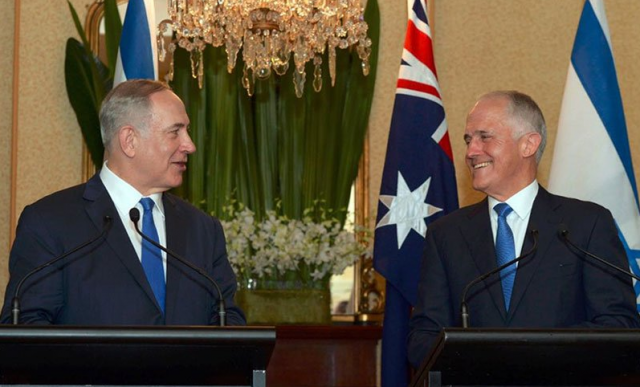
Israel’s Prime Minister Benjamin Netanyahu recently revealed that Israeli intelligence had shared information with our security agencies that foiled an Islamic State plot to blow up an Etihad flight from Sydney last July.

Police arrested two brothers, Khaled Khayat and Mahmoud Khayat, and charged them with plotting to bring down the jet. They’re now before the courts accused of trying to smuggle an improvised explosive device hidden inside a meat grinder onto the plane. The attempt was aborted before they reached airport screening (the device was too heavy to pass through check-in).

The plot had been orchestrated by a senior commander of the Islamic State based in Syria, alarming our security agencies by demonstrating the ability of homegrown jihadis to access technical planning directly from terrorists in the Middle East. Home Affairs Minister Peter Dutton has publicly thanked Israeli authorities for the intelligence tip off. He pointed out that Israel has an ‘enormous capacity’ within its intelligence community and it’s an ‘important relationship with ASIO and the Australian Federal Police’.

During his visit to Australia last February, Netanyahu pointed out that both states had ‘superb intelligence services’ that could be better if they worked more closely together to counter violent Islamist extremism.

Israeli intelligence is now taking a more global approach. It’s part of the international effort to fight radical Islamist terror, with Israeli intelligence bodies having ‘tightened coordination with counterparts in friendly countries in recent years’.

Last May, a storm arose after it was reported that President Donald Trump had revealed in a conversation with the Russian foreign minister and Russian ambassador to the US details of Israeli warnings regarding a plan by Islamic State to blow up passenger jets flying to Europe using laptop bombs.

In January this year, Prime Minister Netanyahu told a group of ambassadors from NATO member states that Israel’s intelligence services had provided information that had thwarted several dozen major terrorist attacks, many of them in Europe. Many could have been the worst kind of mass attacks because they involved threats to civilian aviation, he said.

One of the main challenges our intelligence agencies face is working with fragments of information and trying to assemble a picture of what might happen. In the battle against global jihadism, it’s good to know that along with our core Five Eyes intelligence partners (Britain, the United States, Canada and New Zealand), Israel is increasingly being consulted on terrorism intelligence. Last November Israel and NATO, for example, signed an agreement on protecting classified information to expand intelligence sharing.

Israel plays a pivotal role in Middle East intelligence. We have good information on Islamist extremist groups in Asia that Israel would find of interest. It’s reasonable to assume that Australia and Israel security agencies have been working hard to build trust after the events of eight years ago. At that time, we expelled an Israeli intelligence officer in response to Israel forging Australian passports that were used in the assassination of a Hamas leader.

Last February we had the first visit of a sitting Israeli prime minister to Australia. And last October Malcolm Turnbull made the first visit of a sitting Australian prime minister to Israel since 2000. As a result, we’ve pursued closer ties to Israel through a memorandum of understanding on defence industry cooperation. Our respective defence officials will hold annual discussions on strategic and security priorities.

Consideration might be given in the near future to having a regular defence ministerial-level dialogue and undertaking a small-scale joint Australia–Israel military exercise in an area of mutual interest.

At a time when the cyber threat is growing, this year Australia and Israel will develop closer cooperation in cybersecurity by convening a bilateral cyber dialogue. We can learn lessons from the Israeli cybersecurity success story, particularly in start-ups and skills development. Last year, for example, Israel and the US formed a bilateral cyber security working group.

The intelligence cooperation we received from Israel in rolling up last year’s complex Sydney bomb plot continues a tradition of looking out for your mates, highlighted at last year’s centenary commemorations of the Light Horse’s military campaign in Palestine in Be’er Sheva and ASPI’s own strategic dialogue with Israel’s Begin-Sadat Centre.

21 December 2017

Zentai evades justice


Hungarian-born Karoly (Charles) Zentai, is accused of detaining and beating to death Peter Balasz, an 18-year-old Jewish youth, and throwing his body in the Danube River in Nazi-occupied Budapest in November 1944.
In 2012, Australia’s High Court ruled that the Australian government could not order Zentai's extradition to Hungary to face a criminal trial, because the offence of "war crime" did not exist under Hungary's laws in 1944. The decision was widely criticized as a triumph of narrow legalism over substantive justice. Dissenting judge Dyson Heydon said that the Court’s decision was an "extremely technical one", given that Zentai was wanted for "beating a Jew to death in Budapest in 1944".
A 2006 US-government commissioned report accused Australia of having "an ambivalent" attitude to hunting Nazi war criminals , and a "lack of the requisite political will". The Zentai case confirms this assessment. Zentai died in Western Australia on 13 December 2017, without ever facing trial.
No accused Nazi war criminal has ever been punished in Australia. The US, Canada and the UK all have a far better record than Australia in bringing war criminals to justice, extraditing them and stripping them of citizenship.
Over the years Australia has accepted as citizens accused war criminals not only from World War II but also from the former Yugoslavia, Rwanda, Afghanistan, Indonesia and Cambodia. They blend in seamlessly with the rest of Australian society. Exploiting our tolerance and naivety, they walk freely among us and our children.
Forgiveness can be a powerful healing sentiment in the appropriate circumstances, but not when the wrongdoer seeks no forgiveness, shows no remorse and does everything possible to evade justice.

16 November 2017

The Australia–Israel Be’er Sheva Dialogue: round three

From ASPI, 14 Nov 2017, by Anthony Bergin:


On 1 November, ASPI and the Begin–Sadat Centre for Strategic Studies met in Tel Aviv, Israel, at the third Be’er Sheva Dialogue to build on the work initiated at the first round, held in Israel in 2015, and the second meeting, held in Sydney last year.

The ASPI–BESA dialogue brings together experienced voices from Australia and Israel to share perspectives and analyses on common security challenges, while reflecting more broadly on the outlook for the relationship between the two countries.

Having participated in all three dialogues, I think it’s fair to say that the Be’er Sheva Dialogue (named after the 1917 battle in which the Australian Light Horse fought) has grown in stature. That’s evidenced by the number of high-level Australian and Israeli participants across government, parliament (from both sides of Australian politics), academia, think tanks, industry, the military and the intelligence communities. A number of Australian and Israeli delegates commented that the increasing maturity of the dialogue means there’s now a greater candour and depth to the discussions.

Prime Minister Malcolm Turnbull addressed this year’s dialogue. His audience also included many supporters of the Australia/Israel & Jewish Affairs Council, who’d made the journey to Beersheba to attend the commemoration of the centenary of the famous charge of the 4th Light Horse Brigade to capture the town on 31 October 1917.

Turnbull saluted the achievements that the dialogue had accomplished in a short time, identifying areas of collaboration in defence between Australia and Israel for their mutual benefit. The prime minister’s visit to Israel culminated in the signing of a memorandum of understanding on defence industry cooperation.

Australia and Israel also agreed during Turnbull’s visit that our respective defence officials will now hold annual discussions on strategic and security priorities. To date, there have been almost no high-level military exchanges between the two countries. There’ll also be a track 1.5 cyber dialogue held in Australia next year. These positive measures were suggested at the earlier Be’er Sheva dialogues and were set out in a joint paper produced last year by ASPI and BESA.

We’ve always been seen as friendly by Israel, although it’s rarely been a major focus of policy efforts in Jerusalem. While there’s a mutual recognition of shared values, there hasn’t been sufficient recognition given by either state to how each contributes to the other’s national interests. What both countries are now discovering through high-level visits and track 1.5 dialogues, such as the Be’er Sheva Dialogue, is that there are also lots of opportunities to enhance bilateral cooperation.

In a way, that’s hardly surprising. Both countries face challenges from Islamist extremism. Both countries’ militaries are focused on how to incorporate cyber capabilities into military operations. Both countries operate American equipment and both are close to major choke-points along maritime oil and trade routes, making maritime security an important component of national strategic policy. In air power, both countries have acquired the F-35.

Delegates to the 2017 Be’er Sheva Dialogue exchanged views on regional challenges in the Indo-Pacific, the Middle East and Eastern Mediterranean, terrorism, cybersecurity, maritime strategy (Israel is highly dependent on sea commerce and has significant offshore energy resources), defence industry cooperation, strategic policy under President Donald Trump, and hybrid warfare strategies.

On the cyber and innovation agenda, it was evident that Australia can learn a number of lessons from the Israeli cybersecurity success story, particularly in start-ups and skills development. But we need to be mindful that the Israeli experience may not directly translate to Australia: much of Israel’s success stems from compulsory military service and the unique cybersecurity skills nursery that the Israeli Defence Force provides.

In an interesting aside, one delegate noted that Australia is benefiting from Israeli technology in our almond industry. Significant investments here are safeguarded by Israeli sensors in orchards that tell what the trees need, such as water and fertiliser, making this an unusual cybersecurity issue.

Areas noted for possible future joint exploration were how both sides can counter the soft-power threats to liberal democracies and how to leverage social media monitoring for indicators of radicalisation or intended terrorist acts. It was also clear from our discussions that there are prospects for further joint exchanges on how we can share experiences of hybrid threats and what they mean for the battle space, as well trends in military innovation, specifically unmanned aerial vehicles, force protection and missile defence. There was a strong interest in sharing lessons on how to protect the gas industry at sea.

Australia and Israel should identify the conditions for closer practical collaboration in cyber industries with security applications. Israeli government agencies work closely with their cyber industry. Australia can learn a lot from the Israelis on how to build trust and achieve a common purpose between government and the private sector.

The discussions about China, particularly on critical infrastructure investment in Israel (China is building key Israeli ports and Chinese military vessels have visited Haifa), suggest there’s an opportunity for greater exploration between the two nations on the role of China and foreign investment.

In defence, consideration might be given to undertaking a small-scale joint Australia–Israel military exercise in the coming year in an area of mutual interest. The announcement of defence exchange between officials is very positive, and consideration should be given in the near future to having a regular ministerial-level dialogue.

On international policy, our discussions showed that there’s potential for looking beyond bilateralism and mapping possible structures for discreet multi-party consultations (for example, with India, which Israel is forging closer relations with).

The third Be’er Sheva Dialogue again underlined how each state can contribute to the other’s security interests.

03 November 2017

Australia-Israel: "OUR UNBREAKABLE BOND"

From The Australian, 31 Oct 2017, by The Hon Malcolm Turnbull MP, Prime Minister of Australia:


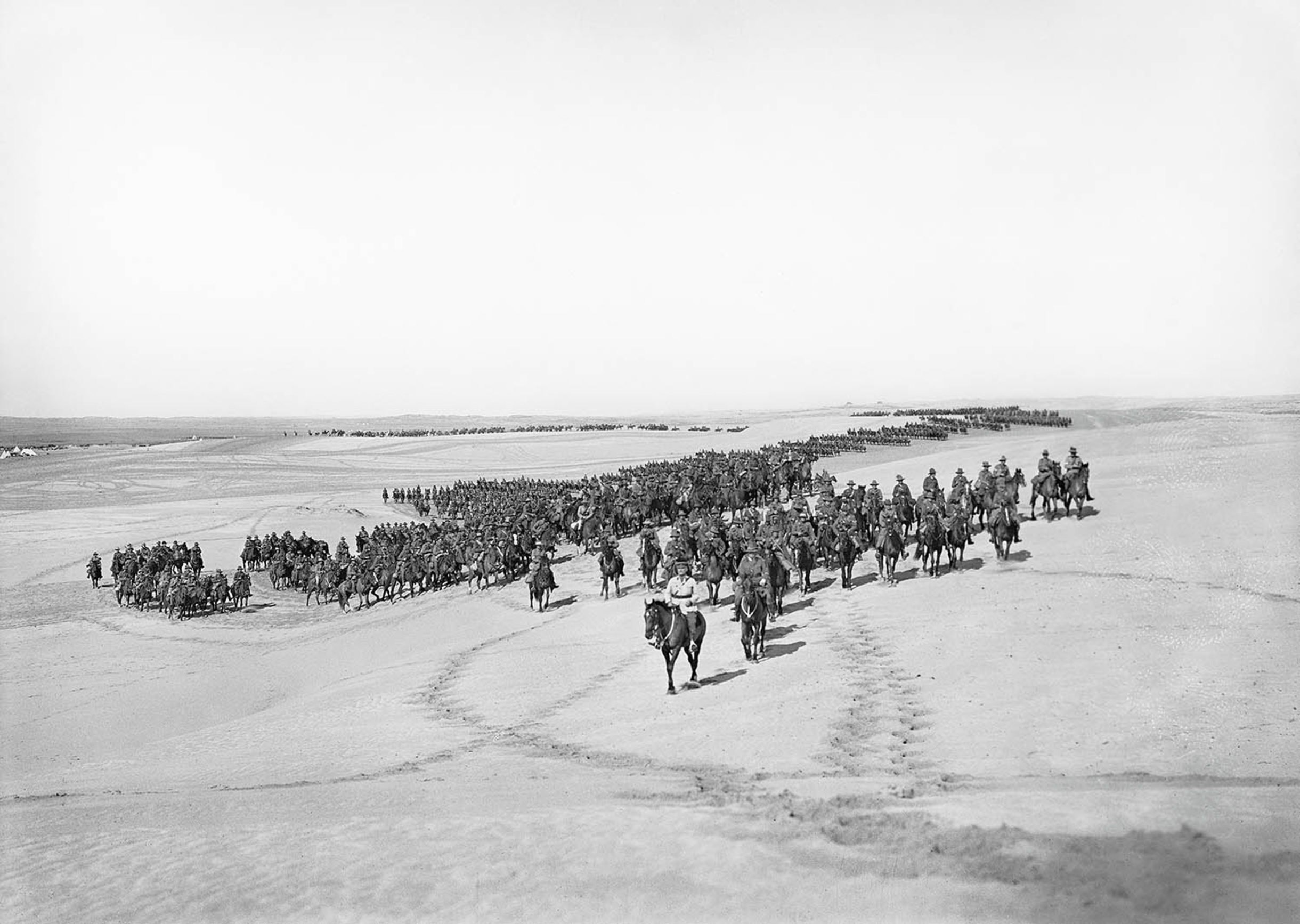
Brigadier General Granville de Laune Ryrie leads the 2nd Australian Light Horse Brigade across the desert at Esdud on the Philistine Plain in 1918

THE CHARGE of the Australian Light Horse at Beersheba has inspired Australians for generations.

The veterans of the charge re-enacted it in Charles Chauvel’s 1940 movie Forty Thousand Horsemen—a confidence booster for a beleaguered nation at war.

As a young boy at boarding school in the early ’60s I watched it again and again—we all imagined ourselves spurring our horses through the Ottoman fire, leaping across the trenches and onward to victory.

Where so many armies had marched and charged before, it was one of the last great cavalry charges, an act of bravery that has echoed through the century since; an against-the-odds victory that broke the Ottoman lines and spurred the Allied forces on to Jerusalem.

The charge itself was an astonishing achievement. At dusk on October 31, 1917, Brigadier General William Grant gave the 800 Australians of the 4th Light Horse Brigade their orders: “Men, you’re fighting for water. Use your bayonets as swords. I wish you the best of luck.”

The cavalry began with a trot, accelerated to a canter and then to a gallop across 6km of open country outside Beersheba, under ferocious fire from well-entrenched Ottoman defenders.
Trooper Edward Dengate recorded the desperate charge. “We spurred our horses… the bullets got thicker… three or four horses came down, others with no riders on kept going, the saddles splashed with blood.”

Brutal hand-to-hand combat followed and 31 Australians were killed. But the 4th Light Horse Brigade prevailed. They had defeated an Ottoman force five times their size, and taken Beersheba and its vital water supply with it.

Just weeks later, the Australians marched with General Allenby into Jerusalem, while in London the Balfour Declaration was signed, paving the way for the creation of the modern state of Israel.

A century on, the city of Be’er Sheva is an oasis of technology and great practical ideas—a shining example of the best attributes of Israel and the Israeli people—ingenuity, resilience, and hard work.

Today, Australia and Israel share these values. We have an unbreakable bond that is only getting stronger. As we honour the memory and sacrifice of the Anzacs of 1917, we are determined to strengthen the ties between our two nations in 2017, and in the years to come.

Lest we forget.


14 October 2017

ABC’s hubris laid bare

From The Australian, October 14, 2017, by GREG SHERIDAN:
 

...Michael Danby, the federal Labor member for Melbourne Ports, has been feeling some moral indignation about the ABC’s coverage of Israel.

... Danby is not a single-issue politician but is a strong supporter of Israel who believes the ABC does not report the nation fairly.

Frankly, no one could seriously contest that proposition.

...Danby took two ads in The Australian Jewish News over a couple of weeks to complain about the treatment of Israel by the ABC’s Sophie McNeill.

The ABC’s Media Watch summarised one ad. It said: 
“The nub of Danby’s complaint is that two recent stories by McNeill received very different coverage. The eviction of a Palestinian family last month after a court returned their home to Jewish ownership scored a two-minute feature on the midday news.
“But the stabbing to death of three members of a Jewish family in July did not receive such personal treatment and was reported only in the context of a surge of violence in which four Palestinians were also killed. They did not get feature treatment either. So, is that bias? Or part of a pattern?”

It is honest of Media Watch to pose the question that way. Let me answer it: Yes, it is a pattern, and yes, it is bias.

The ABC is consistently biased against Israel in a similar way to the BBC and for similar reasons. The overwhelming majority of ABC reporters and general broadcast commentators share a fairly narrow spectrum of world view, ranging from the middle left of Labor to the green left.

This is why the ABC finds it so difficult to come to grips with, or even understand, the complaints this kind of bias generates.

Within their world view these ABC broadcasters mostly behave professionally, and in the field often with heroic distinction. But in that world view, as has been well established in countless books and studies, Israel represents, entirely falsely in my view, Western colonialism, militarism and racism.

This gives reporters and producers an instinct never to represent Israel sympathetically. Jewish Israeli civilians (even victims of terrorism) are almost never portrayed sympathetically on the ABC, unless they are abusing their government or society. Then they are moral heroes.

To humanise an innocent Jewish Israeli grandfather or child brutally murdered in their home by a terrorist seems somehow or other to be supportive of Israel, so it is rarely done.

Danby in his ads was responding to this profound emotional truth. 

The ABC’s response to Danby’s criticisms is dismaying. It exhibits bullying, hubris and unchecked power.

But first a word on McNeill. It is the case that she had a record, before her appointment as a correspondent, of pro-Palestinian activism. It is entirely legitimate for critics of her journalism to point to that history. It’s also entirely legitimate to criticise journalists. This may shock you, dear reader, but there have been occasions when I myself have been criticised, even indeed on the ABC, meaning the criticism came from taxpayers’ money.

ABC broadcasters sometimes darkly refer to “dossiers” that have been compiled on McNeill, as though this involved nefarious access to ASIO files. What they mean by dossiers is articles and footage that McNeill herself has produced. In other words, judging a journalist by their output.

Quelle horreur — surely only the Elders of Zion could plot such fiendish stratagems!

The ABC issued a kind of papal document beatifying McNeill and condemning Danby’s criticism as “highly inappropriate”. McNeill herself issued a bizarre statement demanding Danby be censored. She said: “If using taxpayer dollars to print false claims about a journalist is allowed within parliamentary guidelines, then clearly they need to change.”

Just take a step back and look at the larger picture. Danby, who almost never appears on the ABC, has paid for critical but not remotely abusive ads, the basic accuracy of which is attested by the ABC’s Media Watch, in small-circulation newspapers that might reach 20,000 readers. In response he is attacked, mocked, vilified and condemned in many ABC news programs and by numerous ABC commentators to a cumulative audience in the hundreds of thousands if not millions.

Surely even in the ABC someone must see this is a kind of parody of free speech.

It’s more like the Chinese Communist Party discovering an enemy of the state preaching in a home church and simultaneously denouncing him in People’s Daily, Global Times and the Xinhua News Agency (irony alert, that sentence consciously involves exaggeration, don’t pretend to take it literally).

The ABC did the same thing a couple of years ago when a Jewish old folks’ home withdrew an invitation to the actress Miriam Margolyes to read from an anti-Israel play. All over the country the ABC beat this story to death as a crime against free speech.

Naturally the nursing home didn’t want to debate Margolyes, so she was given uncritical interviews, with no attempt to provide a balancing voice, to a cumulative audience in the hundreds of thousands to berate Israel and defame the Jewish community.

Oi vey!

The implication is always that Jewish criticism of the ABC over Israel is somehow sinister. Two questions: what penalty has any ABC producer or broadcaster ever paid for this criticism? Answer: none. Therefore it is really not too sinister. And is not even the ABC aware of the true, astonishing weirdness of a body that gets more than $1 billion of taxpayers’ money each year trying not to answer criticism but to declare it “inappropriate”?

A more sophisticated broadcaster would have interviewed Danby at length about his criticisms, even if the interview was robust or Danby’s views were answered by somebody else.

The worst part of this saga is that Bill Shorten gave in to ABC pressure and admonished his colleague.

Full disclosure: I have known Danby for more than 40 years, and admired him all that time. He is exactly the kind of person we need in parliament — passionate, fiercely independent, brave as a lion, taken up with human rights concerns in China, Tibet, North Korea, Darfur — a genuine internationalist of which there are almost none in Canberra.

In taking on the colossus of the ABC, Danby spoke truth to power. Good on him.

08 October 2017

The ABC's Sophie McNeill’s Bias

From The Hon. Michael Danby, Member ofr Melbourne Ports, 18 Sept 2017:


Once again ABC Jerusalem correspondent Sophie McNeill has proven to be inconsistent and ignorant in her reporting and handling of news coming out of Israel.


Ms McNeill was passionate in her twitter, play-by-play commentary, of the eviction of the Palestinian Shamesneh family from the East Jerusalem house they had been living in for 50 years. Her emotional plea failed to mention that the Shamesneh’s were squatters in a house that had been vacated during mass evictions, under the Jordanian occupation of East Jerusalem prior to the Six Day War of 1967.

But what of her treatment some days earlier of the tragedy of the Israeli Salomon family who were stabbed to death in their home at their Shabbat dinner table? By contrast with her sympathy for Palestinian family Ms McNeil made only passing reference to the Salomons, without mentioning them by name, as settlers in “occupied territories” Sadly, the death of the three Salomon family members who were gathered around the Shabbat dinner table to celebrate the birth of grandson Yosef, the newest member of the family, is seemingly not news worthy to Ms McNeill. But the Palestinian family, who had to shift are worth a segment on “7.30”

This is an example of the style of Ms McNeill’s reporting. Like her hero John Pilger she dehumanises the side she does not favour by failing to report crucial information about them. She always elevates the Palestinian narrative. This consistent pattern of bias is hard to identify by her editors or ABC views who may not be aware of on the ground events in relation to each other.