18 December 2018

Labor to pursue recognition of "Palestine"

From The Australian, 18 December 2018:

Now it’s time for the resolution on Israel and Palestine.

The resolution notes that conference:

1. Notes previous resolutions on Israel/Palestine carried at the 2015 ALP National Conference and the 2016 NSW Labor Annual Conference;

2. Supports the recognition and right of Israel and Palestine to exist as two states within secure and recognised borders;

3. Calls on the next Labor Government to recognise Palestine as a state; and

4. Expects that this issue will be an important priority for the next Labor Government.

Image result for penny wong
Penny Wong moves the motion.

“I want to acknowledge that the conflict between Israel and Palestine is an issue of great importance to many in our party,” Senator Wong says.

“It is of great importance because Labor is a friend of Israel. I am a friend of Israel.

“It is of great importance because Labor is a friend of the Palestinians. I am a friend of the Palestinians.

“It is of great importance because we, in Labor, not only deal with the world as it is, we seek to change it for the better.

“And so all who have come to this debate do so in the hope of contributing to peace and to a just and lasting resolution of the conflict between these two peoples.”

Senator Wong says the resolution makes clear Labor intends to continue to support the recognition and right of Israel and Palestine to exist as two states within secure and recognised borders.

“And it recognises the desire of this conference to recognise Palestine as a state,” Senator Wong says.

“We recognise that a just two-state resolution will require recognising the right of both the Israeli and Palestinian peoples to live in peace and security.

“Labor will continue to call on both sides of the conflict to refrain from any actions that hamper peaceful outcomes for both the Israeli and Palestinian people.

“And we will continue to ensure that any decision we take contributes to peaceful resolution of the conflict and to progress towards a two-state solution.”

Senator Wong says Labor’s approach was largely bipartisan until recently...

Senator Wong commends the resolution to the conference, saying it makes clear Labor’s commitment to progressing lasting peace and a two-state solution.

Image result for tony burke
Tony Burke seconds Senator Wong’s motion.

“We have reached a point where the arguments to wait have become thinner, and the arguments to act have become stronger,” Mr Burke says.

The motion passes on voices, with cheering and clapping from the floor.

15 November 2018

Australia’s position on the Iran “nuclear deal” and Jerusalem


Statement on Australia’s position on the Iran “nuclear deal” and the prospect of formally recognizing Jerusalem as the capital of Israel 

Our community wholeheartedly supports the prospect that the Australian government will review its position on the Iran “nuclear deal” and the prospect of formally recognising Jerusalem as the capital of Israel and relocating its embassy there. This would be congruent with fundamental Australian values, promote peace and serve our national interests.

Moving the Australian Embassy to West Jerusalem, inside the 1949 Armistice Line, in no way prejudices the outcome of future peace negotiations unless one entertains the prospect that Israel’s long-standing sovereignty in the city is to be removed. Recognising that this is no prospect at all in fact promotes the cause of peaceful co-existence in the region.

Our community overwhelmingly supports modern Zionism as the political movement for the self-determination of the Jewish people. The wider Australian community is also supportive of Israel as the national homeland of the Jewish people.

The intractable, century-long Arab-Israel conflict is regretfully perpetuated by an apparently persistent Arab ambition to destroy Israel as a Jewish nation, which they pursue by demands for a purported “right of return” to Israel within the 1949 Armistice Line, incitement to terrorism, and by paying stipends and pensions to convicted terrorists. (See Appendix 1 for further detail.) Objection to the Jerusalem move are motivated by the same destructive ambition. (See Appendix 2.)

Formal Australian recognition of the obvious fact that Jerusalem is the seat of Israel’s Parliament and all its national institutions recognises the continued existence of Israel as a Jewish nation. Until the Arab side reconciles itself to this, there is little hope of any resolution. Thus, such a move would support Arab-Israel peaceful co-existence. The US move in this direction is clearly intended to discourage continued Arab intransigence and refusal to negotiate. Australia should support it.
Some Arab and Muslim diplomats have criticised the prospect of Australia recognising Israel’s capital, and implied that bilateral relations and trade may be negatively affected. However, trade between the US and Arab and Muslim states, in the 8 months after the US announced in December 2017 that it would move its embassy to Jerusalem, have increased, not decreased. US exports to Egypt have increased by 93.7%, to Qatar by 85.5%, Morocco 22.9%, Lebanon, 16% and to Indonesia by 37.9%. Despite grandstanding and rhetoric by individual diplomats, nations continue to pursue their national interests.

Federal Trade Minister Simon Birmingham correctly pointed out that you “don’t… expect that two nations will always agree in terms of foreign policy positions as they relate to a third nation. But that shouldn’t get in the way of a strong bilateral relationship.”

And Greg Sheridan, in The Australia, 15 November 2018, also said: “Islamist politicians will not like any pro-Israel statement … some Indonesians will object to it. … so be it. It would be completely wretched, and damaging to our national interests, for the Morrison government to back away now from doing anything on the Jerusalem front.”

In relation to the Iran issue, Arab states will applaud Australian reconsideration of its support for the nuclear deal and any increased diplomatic efforts to contain Iranian hegemonic ambitions. It’s no secret that virtually all the Arab states are alarmed by the Iranian threat.

Finally, as the Australia-Israel & Jewish Affairs Council has pointed out: Australian reconsideration of both the Iran and Jerusalem issues will be well received by our most important strategic all: the USA – a critical national interest consideration at a time when Australian security and economic concerns vis-a-vis North Korea and China loom larger than ever.

Appendix 1 – Arab Incitement to Terror
Arab terror attacks in Israel result from explicit calls by the Arab leaders to “spill blood.” Arab children have been taught to idolize the murder of Jews as a sacred value and to regard their own death in this “jihad” as the pinnacle of their aspirations.
The Palestinian Authority incites antisemitism, glorifies martyrdom and encourages terrorism, by awarding generous lifetime pensions to terrorists and their families, on a sliding scale – the more Jews they kill, the higher the pension.
An apprehended terrorist told interrogators in Israel last year: "I've accumulated large debts... I decided to do something serious, such as committing murder... and then my family will get money (i.e., from the PA) and will live comfortably... "
In June 2017, PA District Governor, Laila Ghannam, praised the "Martyrdom " of a 17-year-old terrorist who was shot and killed while throwing Molotov cocktails at Jewish civilians, praising the fact that rather than obtaining matriculation this summer, the terrorist "achieved the highest Martyrdom".
The PA’s incessant incitement perpetuates the conflict and grooms the next generation of terrorists by naming streets, public squares and even children's soccer tournaments after terrorists. In May 2017, the PA inaugurated the Martyr Dalal Mughrabi Center, named after a terrorist leader in the murder of 37 civilians including 12 children, in the Nablus district. In April 2017, Safa, the daughter of Abdallah Barghouti, a terrorist who prepared explosives for attacks in which 67 were murdered, read a letter to her father at her school assembly saying: "Father, I am very proud of you".
The apathy shown by the international community to this death-culture, and the unbalanced way subsequent violence is often treated by the international media is doing long-term, and possibly irrevocable, harm to the Arabs themselves, more than to anyone. Yet there is little international opposition to the exploitation of Arab children.


Appendix 2 – The Muslim Claim to Jerusalem
In relation to the Jerusalem issue, it is instructive to review an essay by historian Daniel Pipes, published in 2001 about the history of Muslim "interest" in the holy city. The following is from the conclusion. (The link for the full essay is https://www.meforum.org/articles/other/the-muslim-claim-to-jerusalem.)
“...Politics, not religious sensibility, has fueled the Muslim attachment to Jerusalem for nearly fourteen centuries; what the historian Bernard Wasserstein has written about the growth of Muslim feeling in the course of the Countercrusade applies through the centuries: ‘often in the history of Jerusalem, heightened religious fervour may be explained in large part by political necessity.’
“This pattern has three main implications.
“First, Jerusalem will never be more than a secondary city for Muslims; ‘belief in the sanctity of Jerusalem... cannot be said to have been widely diffused nor deeply rooted in Islam.’
“Second, the Muslim interest lies not so much in controlling Jerusalem as it does in denying control over the city to anyone else.
“Third, the Islamic connection to the city is weaker than the Jewish one because it arises as much from transitory and mundane considerations as from the immutable claims of faith...
“In modern times, some scholars have come to the same conclusion: ‘Jerusalem plays for the Jewish people the same role that Mecca has for Muslims,’ writes Abdul Hadi Palazzi, director of the Cultural Institute of the Italian Islamic Community...”


13 November 2018

Australians do support recognising Jerusalem


The brouhaha that followed the federal government’s announcement that Australia will consider moving Australia’s Israeli embassy to Jerusalem continues to sputter along. Immediately following the announcement the ABC reported, correctly, that Indonesia’s Foreign Minister Retno Marsudi had expressed concerns about the announcement to Marise Payne. But the ABC also jumped the gun and reported, incorrectly, that Indonesia was considering putting the proposed Indonesia Australia Comprehensive Economic Partnership on hold. The latter proposition was swiftly and emphatically denied by Indonesian Trade Minister Enggartiasto Lukito who confirmed that the deal remains on track to be signed this year. The deal is as much in Indonesia’s interests as Australia’s.
Whilst the Palestinian cause is a highly emotive one within the 56 states of the Organisation of Islamic Co-operation, including Indonesia and Malaysia, none of these states has a record of putting its concerns for the Palestinians ahead of its own national interests. States rarely place sentiment above their national interests.  The Indonesian Trade Minister’s statements should not have come as a surprise.
A second tack taken by critics of the announcement was given voice by the Palestinian Authority’s envoy to Australia, Izzat Abdulhadi, who claimed that moving the Australian Embassy to Jerusalem would be ‘contrary to international law’ and would thus make Australia ‘an international pariah’. To support the claim, Palestinian spokespeople frequently cite UN Security Council Resolution 478 which they say is a decision binding on all States under Article 25 of the UN Charter. However, 478 only applies to action taken by Israel to assert its sovereignty ‘in the Palestinian and other Arab territories occupied since June 1967, including Jerusalem’. Israel’s government precinct is located in the western part of the city, which has been part of Israel’s sovereign territory since 1948. It is not located in the part of Jerusalem ‘occupied [by Israel] since June 1967’. The US Embassy is located in the western part of the city, as would any other embassy, including ours.
A third criticism was the assertion that most Australians are opposed to moving our embassy in Israel to Jerusalem. A Roy Morgan SMS survey undertaken on December 14-15, 2017 was dusted off to support this claim. It asked the question: Do you support or oppose President Trump’s recent decision to declare Jerusalem the capital of Israel? The survey found 76 per cent of Australians opposed the Trump announcement and 24 per cent supported it. Implausibly, there were no ‘Don’t know’s.

The wording of the question suffered from several defects. It linked recognising Jerusalem as Israel’s capital with Trump, who on any view is a polarising personality. It also mis-characterised Trump’s decision. Trump did not ‘declare’ Jerusalem to be the capital of Israel; the US recognised it as already being Israel’s capital.

There is no way of knowing which of those who answered ‘No’ did so because they did not like Trump personally, or were put off by the controversy, or were misled into believing that Trump was ‘declaring’ Jerusalem to be Israel’s capital, rather than because they were opposed in principle to recognising the reality that Israel’s seat of government has for decades been in Jerusalem.
Israel’s parliament, ministerial offices, Supreme Court, President’s residence and PM’s residence have all been located in the western part of Jerusalem since the early days of the state. This is not part of the area that Israel captured during the 1967 war and is not designated by the UN as ‘Occupied Palestinian Territory’. It is not a part of the city that has been the subject of negotiations for a two-state outcome. Locating an embassy in the uncontested western part of Jerusalem would in no way pre-judge the future status of the contested eastern part of the city captured by Israel in 1967. It is ironic that some of those who argue against a unilateral embassy move on the false premise that it would pre-judge a permanent status issue in the Israel-Palestinian conflict, namely the future status of the eastern part of Jerusalem, are the very people seeking to commit Labor at its National Conference in December to extend unilateral recognition to a Palestinian state. That move would necessarily pre-judge a whole raft of issues, including east Jerusalem.
My organisation, the Executive Council of Australian Jewry, was keen to test the veracity of the Roy Morgan survey. We commissioned YouGov/Galaxy to conduct a poll asking: In 1949, Israel designated Jerusalem to be its capital city, and has its parliament there. Do you think Australia should recognise Jerusalem as the capital of Israel? The survey was conducted in February among 1,205 Australians. The demographic distribution of the sample as between age, gender, marital/parental status, geographical location, income level and educational attainment reflected the results of the 2016 census as published by the ABS. The margin of error was plus or minus 2.9 per cent.

The results paint a very different picture to the published Roy Morgan findings. A key finding of the YouGov survey was that when the question of Jerusalem was framed as one of whether to ‘recognise’ (rather than ‘declare’) Jerusalem as Israel’s capital, and was asked without mentioning Trump or the US, Australians supported recognition by a margin of almost two to one (40 to 21 per cent).  Based on party preference, those supporting recognition outnumbered those against in every group except the Greens.
My organisation, the peak representative body of the Jewish community, has long supported recognising the reality that Jerusalem is Israel’s capital and moving the embassy there. Of course Jerusalem strikes an emotional chord for all Jews. It has been our people’s spiritual and political capital since the dawn of the Iron Age 3,000 years ago. 
But we also believe it is in Australia’s interests, and the interests of peoples of the Middle East, for western nations to back the region’s only real democracy, instead of cravenly yielding to threats of retaliation or, worse still, conjuring up the spectre of threats which don’t exist. 
The announcement of the Australian government that it is open to considering whether Australia’s embassy in Israel should be moved to Jerusalem was made four days before the highly-significant by-election for the Federal seat of Wentworth. The timing of the announcement led to a storm of criticism. 
Yet when the issue of recognising Jerusalem as Israel’s capital is considered on its merits, without being accompanied by the hoopla of Australian (or US) domestic politics, the idea enjoys far more support than opposition. Its time will come.

06 November 2018

On the Pittsburgh Synagogue Massacre

by Keith Buxton, on behalf of the Australian pro-Israel Christian community [Minor adaptation of message by Eric Malloy, Bridges for Peace Canada (used with permission)]:

Image result for keith buxton

As millions of Australians mourn the tragic deaths at the Tree of Life Synagogue in Pittsburgh, we re-affirm our support and friendship and will continue to do all within our power to educate and act in support of our Jewish friends and the nation of Israel. We will continue to challenge and educate Australians who hold beliefs and take actions that are antisemitic in nature. As families mourn the loss and injury of loved ones, I recall the words of the Psalmist:
But I trust in you, O Lord; I say, ‘You are my God.’ My times are in your hand; rescue me from the hand of my enemies and from my persecutors! Be strong, and let your heart take courage, all you who wait for the Lord! (Psalm 31:14, 15, 24)
Antisemitic words and actions are on the rise in Australia. Most of this evil is perpetrated by far left or far right groups, organisations, and individuals, and by radical Islamists. Political, religious, business, academic, and social leaders are bombarded by lobbyists who are biased against or in outright opposition to Israel and the Jewish people. Many Australian colleges and universities welcome incendiary speakers and educators who spew hate for Israel and Jews, yet refuse to permit pro-Israel speakers and educators to be heard. Some so-called Christian denominations have consciously decided to join the Israel hate-fest and are a discredit to their Christian faith and the Bible that informs it. This hypocrisy fuels antisemites, Holocaust deniers, and radicals. Actions like the Tree of Life Synagogue tragedy are in large part rooted in these and other related factors. I appeal to Australian lawmakers, interpreters, and enforcers to take decisive action before it’s too late.

Members of Parliament and other political leaders have the responsibility to address these evils, to legislate against them, and to enforce that legislation. In many cases, simply enforcing the existing legislation would help stem the tide. Those who participate in BDS and hate need a wake-up call. Clear-minded Australians will not tolerate it. Those who falsely claim “human rights” abuses need to be confronted and have their “story” debunked. Australian politicians need to sift through the rhetoric and stand firm on truth and true justice - not the injustice falsely peddled as justice. Prime Minister Scott Morrison needs to continue to take a lead on this, to do what is right because it is right, to reject voices that support antisemitic or anti-Israel libels and violence, and to be on the right side of history.
MPs who are being lobbied need to fact-check. They need to be informed by reliable sources and to be reminded of self-evident, easily confirmed facts. Those who promote libels need to be identified and exposed for their lies. Those who falsely accuse Israel of apartheid need to observe the obvious: Israel is a free and liberal democracy, and it is many of her neighbours that actually practice racial segregation - against Jews. This is vividly evident with the Palestinian Authority who wants their version of “history” and national aspiration to be respected while denying the Jews theirs. Worse yet, many seemingly intelligent Australian and world leaders act as if this is acceptable. Those who protest by boycotting Israel in Australian institutions and society need to reconsider whether there is any wisdom in boycotting the source of vast breakthroughs in technology, medicine, education, agriculture, defence, emergency response, and human aid, not to mention giving medical treatment to victims of civil conflicts in Syria and Lebanon.

Supporting Israel does not mean demonstrating hate for other nations and people-groups in the region. It’s time for people and organizations to get off the Israel hate-wagon and dialogue in a civil manner. Then maybe some of the fuel for these barbaric incidents would be gone. That sounds like a fair request.


17 October 2018

The Muslim Claim to Jerusalem

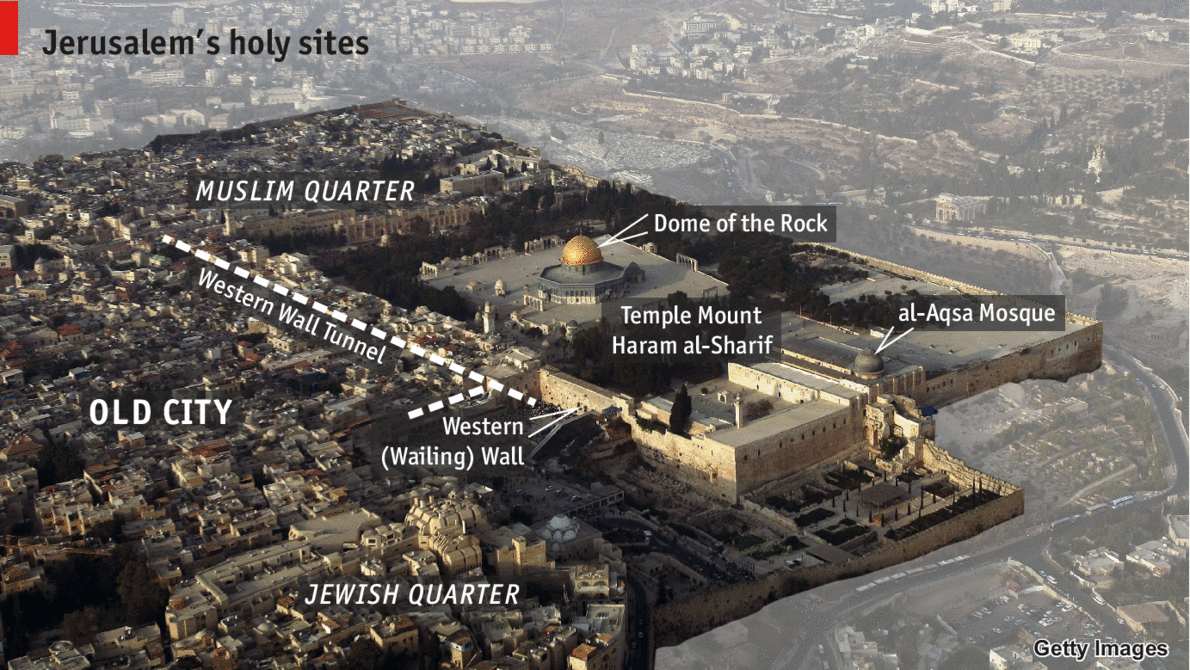
Given the topical interest currently, in the prospect of Australia moving its Israeli Embassy to Israel's capital: Jerusalem; it is instructive to review Daniel Pipes' essay, published in 2001 about the history of Muslim "interest" in the holy city.

Follow the link for the full essay. The following is from the conclusion.

Image result for jerusalem temple mount

Politics, not religious sensibility, has fueled the Muslim attachment to Jerusalem for nearly fourteen centuries; what the historian Bernard Wasserstein has written about the growth of Muslim feeling in the course of the Countercrusade applies through the centuries: 
"often in the history of Jerusalem, heightened religious fervour may be explained in large part by political necessity." 
This pattern has three main implications. 

First, Jerusalem will never be more than a secondary city for Muslims; "belief in the sanctity of Jerusalem... cannot be said to have been widely diffused nor deeply rooted in Islam." 

Second, the Muslim interest lies not so much in controlling Jerusalem as it does in denying control over the city to anyone else. 

Third, the Islamic connection to the city is weaker than the Jewish one because it arises as much from transitory and mundane considerations as from the immutable claims of faith.

Mecca, by contrast, is the eternal city of Islam, the place from which non-Muslims are strictly forbidden. Very roughly speaking, what Jerusalem is to Jews, Mecca is to Muslims – a point made in the Qur'an itself (2:145) in recognizing that Muslims have one qibla and "the people of the Book" another one. The parallel was noted by medieval Muslims; the geographer Yaqut (1179-1229) wrote, for example, that "Mecca is holy to Muslims and Jerusalem to the Jews." 

In modern times, some scholars have come to the same conclusion: "Jerusalem plays for the Jewish people the same role that Mecca has for Muslims," writes Abdul Hadi Palazzi, director of the Cultural Institute of the Italian Islamic Community.

The similarities are striking. Jews pray thrice daily to Jerusalem and Muslims five times to Mecca. Muslims see Mecca as the navel of the world, just as Jews see Jerusalem. Whereas Jews believe Abraham nearly sacrificed Ishmael's brother Isaac in Jerusalem, Muslims believe this episode took place in Mecca. The Ka'ba in Mecca has similar functions for Muslims as the Temple in Jerusalem for Jews (such as serving as a destination for pilgrimage). The Temple and Ka'ba are both said to be inimitable structures. The supplicant takes off his shoes and goes barefoot in both their precincts. Solomon's Temple was inaugurated on Yom Kippur, the tenth day of the year, and the Ka'ba receives its new cover also on the tenth day of each year. If Jerusalem is for Jews a place so holy that not just its soil but even its air is deemed sacred, Mecca is the place whose "very mention reverberates awe in Muslims' hearts," according to Abad Ahmad of the Islamic Society of Central Jersey.

13 September 2018

Australian-Government suspends funding to Union Aid Abroad after further terrorism links are revealed

From The Daily Telegraph, September 13, 2018, by Sharri Markson,  National Political Editor:

THE federal government has suspended taxpayer funding to a union charity after it was ­revealed a Palestinian organisation receiving aid employed a second member of a listed terrorist group.
 
Union Aid Abroad — APHEDA, which was set up by unions and has been run by federal Labor MPs including Ged Kearney, has received $21 million of public funds, millions of which has made its way to a Palestinian organisation called the MA’AN ­Development Centre.


Hamza Zbiedat is a supporter and affiliate of terrorist organisation the PFLP and is employed by the MA’AN Development Centre which receives APHEDA funding. 
 
The Daily Telegraph can reveal the MA’AN Development Centre is employing as a field and media co-ordinator, Hamza Zbiedat, who is a supporter and affiliate of terrorist organisation, the Popular Front for the Liberation of Palestine (PFLP).
 
The PFLP is on the official terror list of the US, the European Union and Canada, as a result of its history of hijacking of planes, assassinations and suicide bombings, while Australia has the group on its “Consolidated” list of organisations subject to financial sanctions as a result of terror and security threats.


Zbiedat, who was arrested by Palestinian Authority secu­rity forces on October 14, 2017, is the second PFLP affiliate employed the MA’AN Development Centre.
 
In June, The Daily Telegraph revealed the same org­anisation had employed since 2012 a leader of the PFLP in Gaza, Ahmad Abdullah Al Adine, 30, as their Project Co-ordinator and Field Monitor.


He was killed during the riots at the border of Gaza and Israel in May and he was hailed as a “martyr” at his ­funeral, which was attended by at least a dozen armed PFLP terrorists wearing balaclavas...


Ahmed Abdulla Al Adine, a leader of 
of terrorist organisation the PFLP, and was employed by the MA’AN Development Centre which receives APHEDA funding. He was shot by an Israeli sniper during the riots at the border of Gaza and Israel, on May 14, 2018. 


Ahmed Abdulla Al Adine’s body is carried during his burial as he was hailed as a “martyr”.

At least a dozen armed PFLP terrorists wearing balaclavas attended his funeral.
 
After being alerted to the evidence ...the government has now suspended all Australian funding to the Labor-aligned charity.
 
In June, former foreign minister Julie Bishop ann­ounced an audit into the funding, but did not suspend it.
 
But shown the evidence concerning a second current employee, Ms Bishop, in one of her final acts as foreign minister, halted funding to Union Aid Abroad — APHEDA.

“The former Foreign Minister initiated an audit of APHEDA’s Australian aid-funded program in the Palestinian Territories on 27 June. “The audit is due to be completed by the end of the year,” Foreign Minister Marise Payne’s spokesman said. “The former foreign minister suspended APHEDA’s Australian aid-funded programs in the Palestinian Territories until the audit is complete. “The Australian Government has zero tolerance of any diversion of aid funding from its stated development purpose.”
Union Aid Abroad — APHEDA’s executive officer Kate Lee did not respond to questions about whether she had made any moves to investigate links between MA’AN Development Centre’s staff and terror organisations since The Daily Telegraph’s first ­report in June.
 
Ms Lee would also not respond to questions about whether it was appropriate funds went to an organisation that employees leaders and affiliates of a terror group....

05 September 2018

AIJAC will lodge a complaint about ABC TV story on Israel’s Nation-State Law

The Australia/Israel & Jewish Affairs Council (AIJAC) is very disappointed at the one-sided and misleading report on the September 4 edition ABC TV’s “7.30”, covering Israel’s Nation State Law. 


ABC Israel correspondent Sean Rubinsztein-Dunlop

While the law is controversial, and is opposed by many Israelis of all religions and political persuasions, the report by “7.30” included some false statements and lacked context.

In her introduction to the report, host Leigh Sales stated the law “defines the country as exclusively a Jewish state.” This is not true. While it does state that Israel is the national home of the Jewish people, and that the “right to exercise national self-determination in the State of Israel is unique to the Jewish people” this simply restates what is well known – that Israel is the state for the Jewish people, as set out in Israel’s Declaration of Independence and other Basic Laws, not to mention the original UN partition resolution. It does not mean Israel is now “exclusively” Jewish.

Sales also claimed, “The so-called nation-state law is the latest in a series of policies seeking to enshrine Jewish supremacy amidst a surge in ultra-nationalist sentiment.” The claim of “Jewish supremacy”, that Jews have more rights than other Israeli citizens, is simply incorrect – all Israeli citizens have equal rights. The claim about “ultra-nationalist sentiment” is also a skewed and inaccurate representation of the reality in Israel and an inappropriate attempt by the ABC to pass a subjective judgement on this and other recent Israeli laws.

Similarly, in his report, Sean Rubinsztein-Dunlop claims the law “defines Israel as exclusively the nation state of the Jewish people,” and says, “Under a divisive new law, these two Israeli citizens are no longer equals. Because Mira Awad is an Arab, Israel is officially no longer her nation.” This is patently untrue. All citizens of Israel, regardless of religion or ethnicity, have equal rights. There are other basic laws – Human Dignity and Liberty and Freedom of Occupation (meaning jobs) – which have equal standing and which guarantee the human rights and equality of all Israelis. Rubinsztein-Dunlop’s implication that this law supersedes all those other laws is simply incorrect.

Rubinsztein-Dunlop also states that the Nation State Law doesn’t contain the words “democracy” and “equality” in its definition of Israel, and while this is true, the Basic Law: Human Dignity and Liberty states, “The purpose of this Basic Law is to protect human dignity and liberty, in order to establish in a Basic Law the values of the State of Israel as a Jewish and democratic state,” and then applies its protections equally to all.

Rubinsztein-Dunlop states the law “puts Hebrew above Arabic as the only official language,” and while it is true that the law states, “The State’s language is Hebrew,” if Rubensztein-Dunlop wished to give the relevant context, he would have also noted that the law provides, “The Arabic language has a special status in the state; Regulating the use of Arabic in state institutions or by them will be set in law,” and that the clause making Hebrew the language of the state “does not harm the status given to the Arabic language before this law came into effect.”

It is also worth noting that all other Middle Eastern countries are specified in their constitutions or equivalent as Arabic or Islamic or both. In the Palestinian Authority, which demands that no Jews can live in any future Palestinian state, it’s both. In addition, many European and Asian countries have laws giving preferred status to the culture of the dominant ethnic group, religion or language, or defining the country by reference to them. Yet somehow it’s only when Israel, which the UN specifically established as a “Jewish state”, confirms that status that the ABC deems it worthy of a critical current affairs report.

AIJAC Executive Director Dr Colin Rubenstein stated, 
“Yet again, we have the unfortunate situation where the ABC has failed to properly cover a complicated issue involving Israel. There have been both sins of commission, with false statements and mischaracterisations, and sins of omission, where context crucial to give viewers a full understanding of the issues was totally lacking. The Australian viewing public and taxpayers are entitled to expect far better from their ABC.”
AIJAC will be submitting a formal complaint.